
What is HoWA?
An easier, clearer way to understand and manage your home.
4 questions
Edition 01|Your home, your Score and your privacy
Find quick answers about HoWA, your Home Record, your HoWA Score, sharing and moving home.

Browse by topic
An easier, clearer way to understand and manage your home.
4 questions
A clear, evidence-led view of your home.
4 questions
You stay in control of what's shared.
4 questions
Support for a smoother, more transparent move.
4 questions
Feel informed and confident.
4 questions
Featured FAQs
Short, straightforward answers to the questions we get asked most.
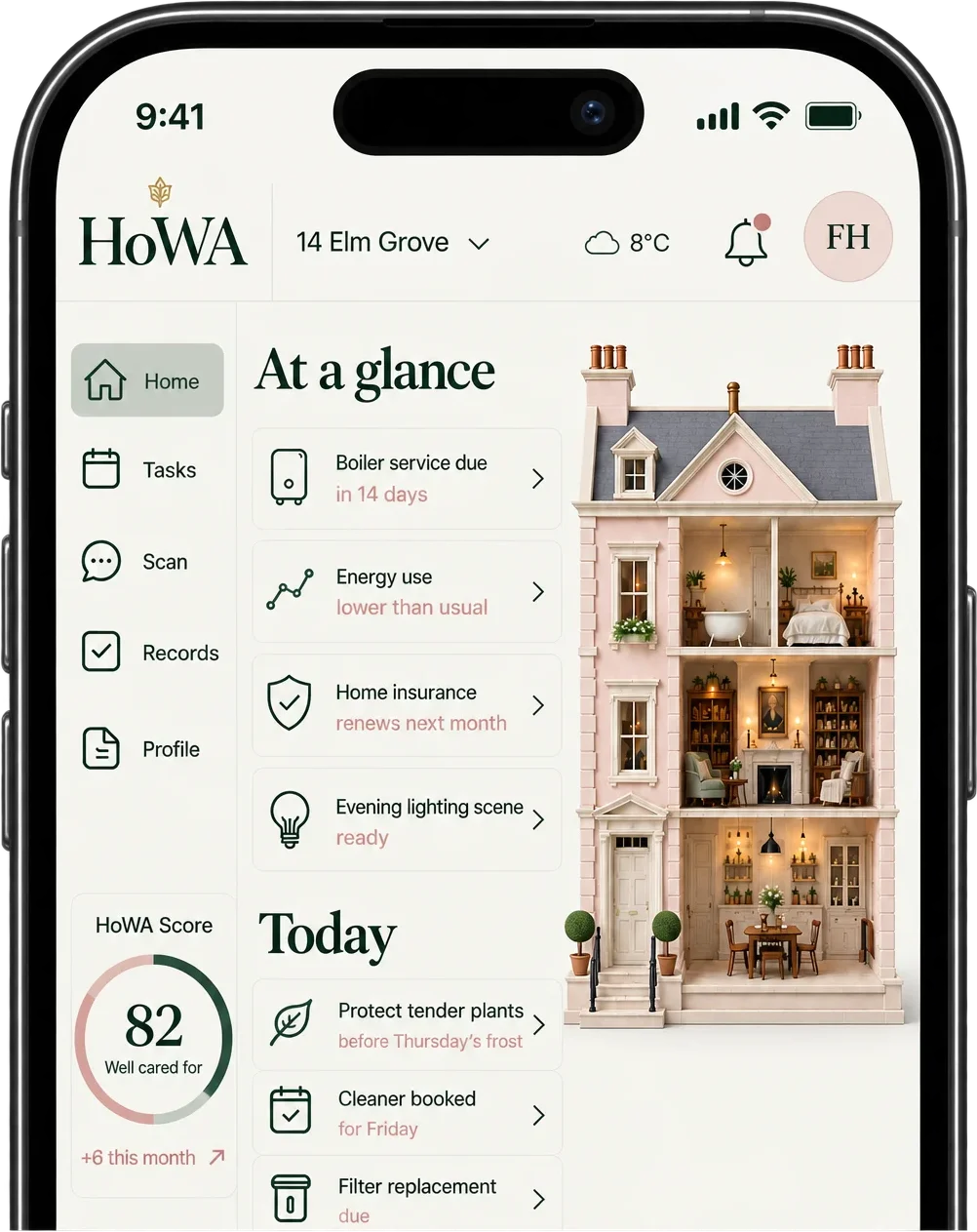
HoWA is Home Intelligence. It gets to know your home and the way you live in it: your preferences, your style and the rhythm of your week.
It uses that to suggest what to do and when, in ways that suit both your household and your property. Give it a receipt, a warranty or a photo of the boiler and it works out where each detail belongs and notices what's coming up. Ask a question and the answer is about your home, not homes in general.
The more it learns, the more useful it becomes. You decide what it remembers and what happens next.
No. HoWA is designed to be useful even when you are not buying anything. You might use it to find a warranty, remember a service date, plan a room, save an idea or ask a question about your home.
Arranging professional help is one possible next step, not the purpose of every interaction.
Your Home Record is designed to keep the useful history of the property together: its rooms, garden, appliances, systems, manuals, warranties, maintenance and completed work.
It is different from Household Memory, which holds your personal tastes, routines and preferences. That distinction matters when information is shared or you move home.
The HoWA Score is designed to explain what the recorded evidence says about your home's condition and care. It should help you understand what needs attention and why.
The number needs to be read alongside its supporting information, date and confidence. It is not a survey, a valuation or a guarantee that nothing is wrong.
Not necessarily. Confidence describes how much the available evidence supports the reading. Low confidence can mean there is not enough information to draw a reliable conclusion.
Missing paperwork is not the same as evidence of a defect. A new or sparsely documented home needs an honest explanation of what is known and what is still uncertain.
A private question is not the same as a confirmed defect. Asking about a possible damp patch, for example, should not automatically turn an uncertain concern into verified property evidence.
The planned approach distinguishes questions, reported concerns and professional evidence. Genuine evidence may affect the Score, but private conversations, purchases and ordinary task ticks should not be treated as proof of a change in the property's condition.
“A clearer picture of your home”

Start here
Jump straight to the answers people look for most.
What is HoWA?
HoWA is Home Intelligence. It gets to know your home and the way you live in it: your preferences, your style and the rhythm of your week.
It uses that to suggest what to do and when, in ways that suit both your household and your property. Give it a receipt, a warranty or a photo of the boiler and it works out where each detail belongs and notices what's coming up. Ask a question and the answer is about your home, not homes in general.
The more it learns, the more useful it becomes. You decide what it remembers and what happens next.
No. HoWA is designed to be useful even when you are not buying anything. You might use it to find a warranty, remember a service date, plan a room, save an idea or ask a question about your home.
Arranging professional help is one possible next step, not the purpose of every interaction.
The planned introduction starts with the right home, not a long form. You would confirm your address, see what information is already available, save one useful document, ask a question and choose a practical next step.
You do not need to inherit a record from the previous owner to begin. The aim is a useful starting point, not a complete assessment of your home in five minutes.
Your Home Record is designed to keep the useful history of the property together: its rooms, garden, appliances, systems, manuals, warranties, maintenance and completed work.
It is different from Household Memory, which holds your personal tastes, routines and preferences. That distinction matters when information is shared or you move home.
Understanding your HoWA Score
The HoWA Score is designed to explain what the recorded evidence says about your home's condition and care. It should help you understand what needs attention and why.
The number needs to be read alongside its supporting information, date and confidence. It is not a survey, a valuation or a guarantee that nothing is wrong.
Not necessarily. Confidence describes how much the available evidence supports the reading. Low confidence can mean there is not enough information to draw a reliable conclusion.
Missing paperwork is not the same as evidence of a defect. A new or sparsely documented home needs an honest explanation of what is known and what is still uncertain.
It is linked to your home, not to your personal profile or membership. The HoWA Score is a property-bound digital asset, designed to remain with the property's appropriate history through an authorised handover.
The number can change as the evidence changes. Your private Household Memory moves with you; it is not passed to the next owner. Property-bound does not mean publicly accessible.
A private question is not the same as a confirmed defect. Asking about a possible damp patch, for example, should not automatically turn an uncertain concern into verified property evidence.
The planned approach distinguishes questions, reported concerns and professional evidence. Genuine evidence may affect the Score, but private conversations, purchases and ordinary task ticks should not be treated as proof of a change in the property's condition.
Sharing with your estate agent
Not simply because they introduced you to HoWA. The proposed agent-sharing feature would let you approve a limited Property View rather than give the agent access to your account.
They would sign in separately and see only the property information you had authorised. They would not receive your login or access to your private Household Memory.
The proposed view could include selected property details, reviewed certificates, warranties, maintenance history and preparation tasks. A Score would appear only with an appropriate explanation of its evidence and limitations.
Your agent could request missing information or submit material for review. They would not be able to edit your Score, overwrite your record or see private chats, payment details or unrelated homes.
In the proposed sharing flow, you would choose the recipient and information, review the exact view they would receive, and approve how long access lasts.
For example, you could share a reviewed boiler-service record without opening your inbox to the agent. New uploads, changed documents and additional recipients would need their own approval rather than silently becoming visible.
An address alone must not grant access to your home's private records. Finding the property is different from proving authority to manage or share its information.
The proposed access process would check that authority. Where ownership or representation is disputed, access or transfer would pause for review rather than being granted automatically.
Moving home and staying in control
The intention is to pass on appropriate property history, not your private life. Your Household Memory, private conversations and personal routines are separate from a property handover.
Even a property document can contain personal details. The proposed handover would therefore review what is shared and remove inappropriate personal information, rather than automatically transfer every invoice, photograph or message.
The proposed controls would let you end future access, with sharing also ending when its permission expires. Removing access needs to stop the information being retrieved, not just hide it from a screen.
It cannot recall a screenshot or a copy already downloaded. The download options and any limits on removing shared copies need to be clear before you share.
Under the proposed approach, an ended instruction or failed sale would trigger a review of the access you granted. A replacement agent would need separate approval; a prospective buyer would not inherit the agent's access.
A completed sale would use a separate authorised handover. Your former access, and your agent's, must not reveal the new owner's private activity.
Not under the proposed approach. Saving a kitchen, garden or room idea should help you explore what you like, not automatically send your details to an estate agent.
Requesting a valuation, asking about a property or arranging an introduction would be a separate choice. Your private interests and conversations would not form part of the shared Property View.
Checking information and accepting an offer
The proposed sharing approach would let you approve selected information. But a selection of documents should not be presented as a complete assessment or full property history.
It would not produce a more favourable Score by recalculating it from only the selected documents. Any shared reading would need its date, explanation and relevant limitations; it may not be suitable for display without them.
An incorrect entry needs checking against its source, not treating as an established fact. The proposed correction process would let you flag the entry and explain the problem, with human review for significant disputes.
A correction could change the underlying evidence and, where relevant, the Score. It would not guarantee a higher number. The exact review process and response arrangements still need to be confirmed.
For the proposed offer, accepting three complimentary months of HoWA Steward would be separate from sharing your property information or choosing marketing.
You would make those choices separately, and declining optional sharing would not cancel the gift. The offer and its final terms still need to be confirmed.
The terms of the proposed offer have not yet been confirmed, so renewal, possible charges and access afterwards are not settled. Those terms need to explain exactly what happens before you accept the offer.
Rules for existing members, people who both sell and buy, and sales lasting longer than three months also remain to be confirmed. Do not assume that two introductions automatically provide six months.
Can’t see your question? Ask HoWA or get in touch.
Still need help?
Get answers about your own home, or create your Home Record to see what’s possible for your home.